Competitor research (lesson 2.3) is a snapshot. Competitor tracking is the film: the same numbers every month, so you see who's growing, who's slipping, and which keywords are changing hands.
Step 1: Track a competitor
On Competitors, open a domain you've researched and click Track monthly. Tracking doesn't use lookups. Pro tracks up to 5 competitors and Scale 15.
We tracked ieltsliz.com, in India. SEODojo adds your own site as the first row automatically, so you're always comparing against yourself.
Step 2: Read the table
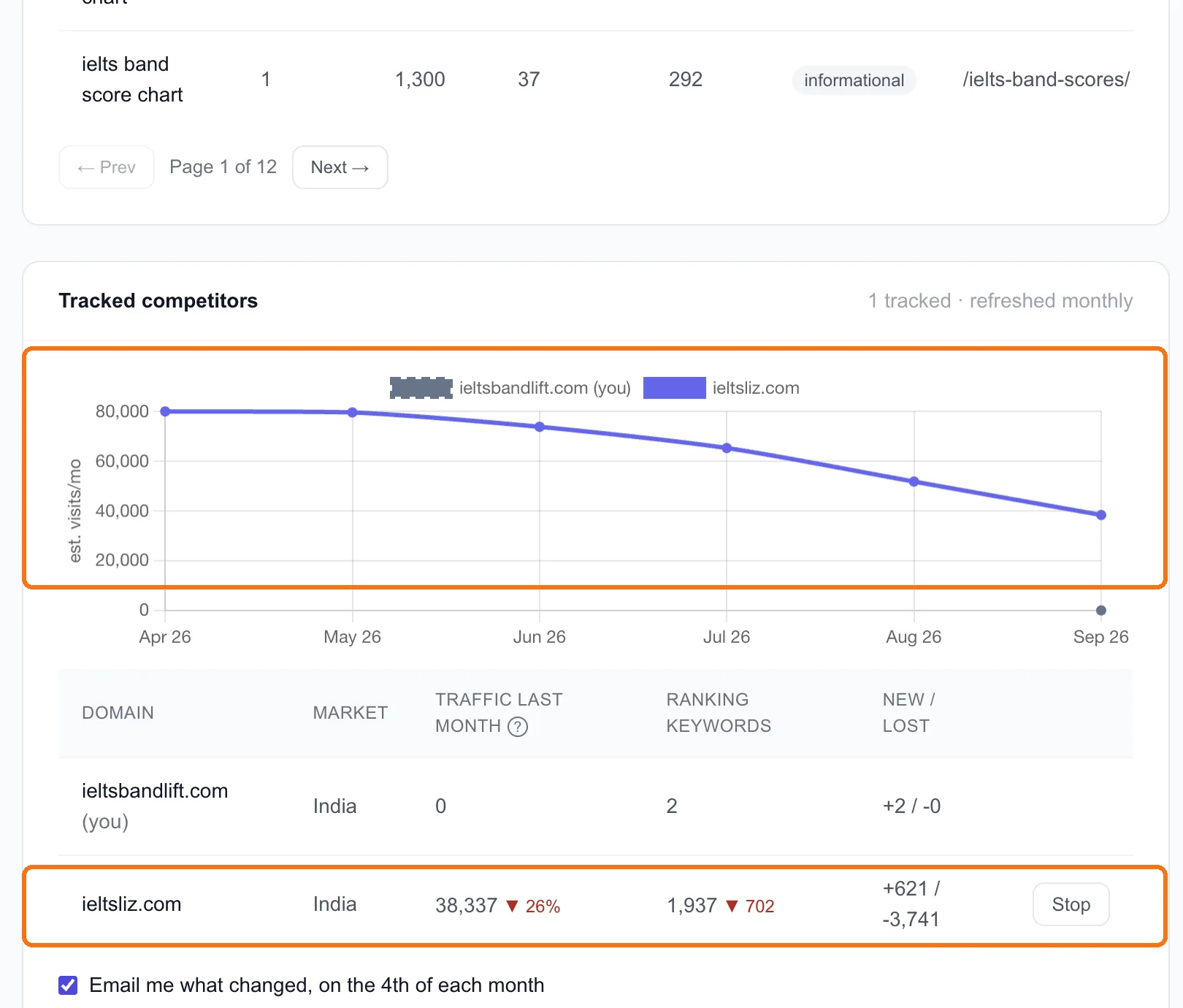
Our first comparison:
| Domain | Traffic last month | Ranking keywords | New / lost |
|---|---|---|---|
| ieltsbandlift.com (you) | 0 | 2 | +2 / −0 |
| ieltsliz.com | 38,337 ▼ 26% | 1,937 ▼ 702 | +621 / −3,741 |
Two things stand out.
Ours is tiny, and that's fine. 2 ranking keywords and no measurable traffic is our starting point, and it's the number this course is trying to move. Next month's row is the one to watch.
ieltsliz.com fell 26% in a month. It gained 621 keywords and lost 3,741. The chart above the table goes back further: from about 80,000 estimated visits a month in April to about 38,000 in September, roughly half. For a long-established site, that's a big, steady slide, not a one-month blip. We don't know why yet, and it's worth being careful about guessing. It could be a Google update, more AI Overviews answering IELTS questions directly on the results page, newer competitors, or seasonality around test dates.
What we can do is look, because that's what tracking is for:
- Open its Ranked keywords and see which kinds of keywords it lost. Were they "how to" questions, which AI Overviews now often answer, or specific test tasks?
- Check whether any of the lost keywords are ones we could target (lesson 2.3's gap).
- Check next month whether the slide continues. The chart already shows six months of it, so this is a trend, not a blip, but the cause still needs looking into.
Tip: A competitor losing rankings is an opening only if someone better replaces them. Look at who's ranking now for the keywords they lost. If it's a page like the one you could write, that's your next article.
Step 3: Let the email do the watching
Email me what changed, on the 4th of each month sends the summary to you. Like the AI visibility digest (lesson 7.6), it means you don't have to remember to look.
Pick who to track
Track up to three sites, each for a different reason:
- The leader (for us, ieltsliz.com): where the market is going.
- A site about your size: whose wins you can copy soonest.
- Whoever keeps beating you on your most important keyword: lesson 6.1's rank tracking will tell you who that is.
Done when
- One to three competitors are tracked, each for a reason
- You've read the first comparison, including your own row
- For any big change, you've looked at which keywords moved before guessing why
- The monthly email is on