Ask ChatGPT "what are the best apps for IELTS writing practice?" and it doesn't look the answer up in a database of apps. It does one of two things, and which one matters a lot for you.
Two ways an AI engine answers
From memory. The model answers from what it learned in training: a huge amount of text from the web, up to a cutoff date. Nothing it learned after that date exists for it. When we asked ChatGPT's API our IELTS question in lesson 7.4, the answer started "As of my last update in October 2023". That's a memory answer. A site launched after that can't be in it.
From a search. The engine turns the question into one or more web searches, reads a few of the pages that come back, and writes its answer from them, often with links to the pages it used. ChatGPT, Perplexity and Gemini in their apps, Claude with web search, and Google's AI Overviews and AI Mode all work this way for questions like ours.
Search answers are where a new site can win, because they're built from today's web. Memory answers come later, if at all.
Note: DeepSeek doesn't search the web, so every DeepSeek answer is a memory answer. It's still worth tracking, because it shows which brands are established enough to have been learned.
What they actually cite
We tracked five questions for ieltsbandlift.com across seven engines for a week (lesson 7.1). Here's what they read:
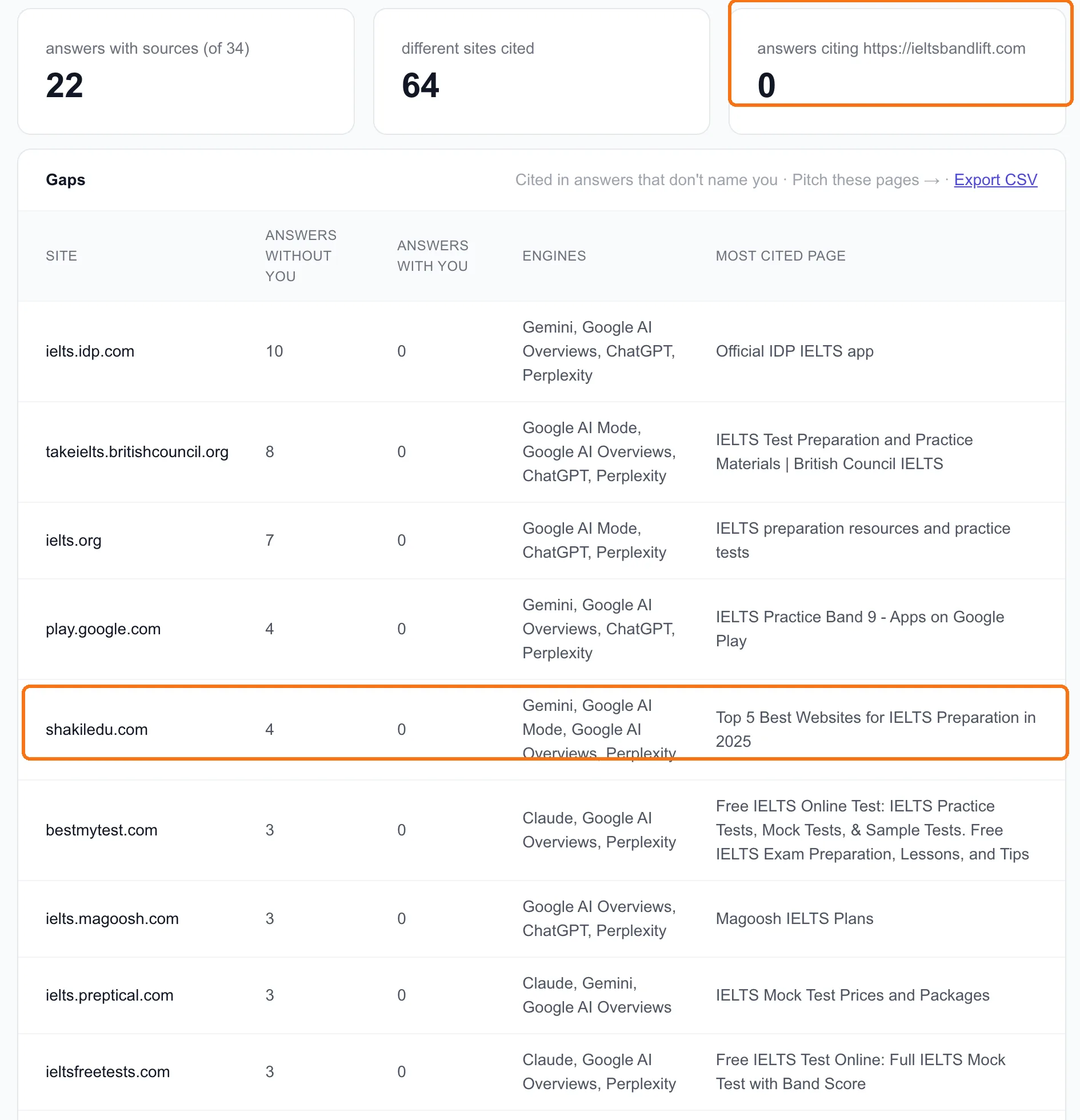
22 of the 34 answers listed sources, and between them they cited 64 different sites. The ones that kept coming up fall into four groups:
- The official sources. ielts.idp.com (10 answers), takeielts.britishcouncil.org (8), ielts.org (7). For a question about an exam, the people who run the exam come first. Every topic has its equivalent: the official docs, the standards body, the government page.
- Lists and comparisons. "Top 5 Best Websites for IELTS Preparation in 2025", "10 Best IELTS Preparation Apps in 2026". A question that asks for options gets answered from pages that list options.
- App stores and product pages. play.google.com came up in 4 answers, and competitors' own plan and pricing pages (ielts.magoosh.com, ielts.preptical.com) in 3 each. When the question is about apps or prices, engines go to where apps and prices are.
- Real people talking. quora.com and reddit.com. Engines like to back up a recommendation with someone who isn't selling anything.
Notice what's not there much: generic blog posts that say what everyone else says.
Different engines, different sources
The engines don't all read the same pages. In our data, Google AI Overviews was the one citing Quora and YouTube. Perplexity and ChatGPT leaned on the official IELTS sites. Claude cited the free mock-test sites. That's why one engine's answer never tells you the whole story, and why lesson 7.1 tracks all seven.
What makes a page easy to cite
An engine reading a page in a hurry needs to lift a clear answer out of it. Pages that get cited tend to share a few things:
- The answer comes early and is said plainly. "The fastest way to improve your speaking score is…" beats three paragraphs of background.
- They list and compare. A question that asks for options is answered from a page that names options, with a line on each.
- They're current. A "2025" list still gets cited in late 2026, but it's the kind of page that gets replaced as soon as a fresher one appears.
- Crawlers can read them. If your robots.txt blocks AI crawlers, or your content only appears after JavaScript runs, the engine may never see it. Lesson 5.3 checks this.
And remember the biggest one: you don't have to be the source to be in the answer. Getting named on a page the engine already reads works just as well. That's what lesson 7.2 is about.
Done when
- You can explain the difference between a memory answer and a search answer
- For your own topic, you can name the official sources, the list articles, and the forums an engine would probably read
- You've checked that your own best page puts its answer in the first few sentences