Google's job is to show the page that best answers the search. Everything it measures is a way of guessing that. You don't need the hundreds of signals people like to list. You need to understand three questions Google is effectively asking about every page, and you can see all three by looking at one real first page.
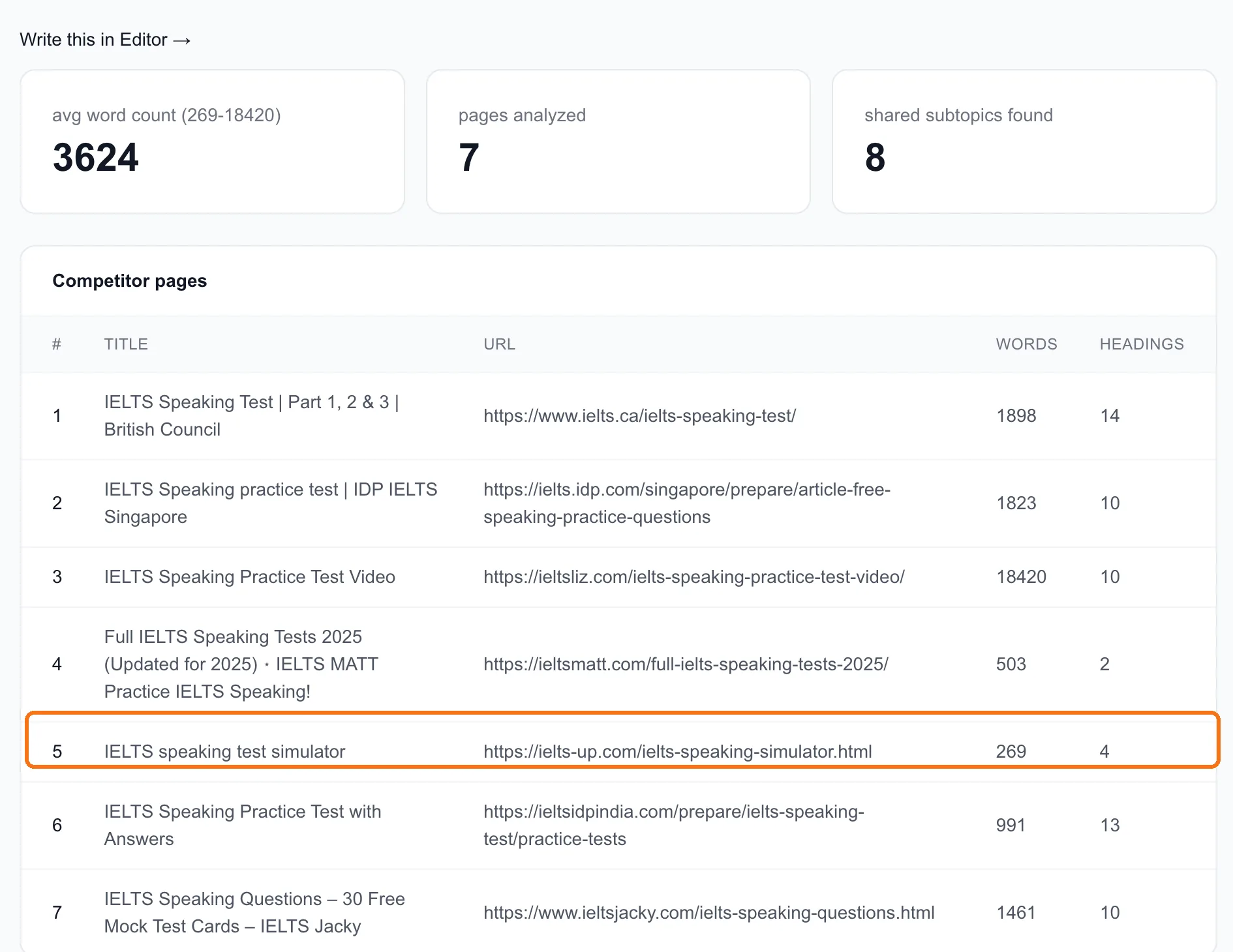
So let's look at one. We searched "ielts speaking practice" in India, a keyword our demo site, ieltsbandlift.com, wants to rank for. SEODojo's SERP Analyzer read the pages ranking for it:
1. Does the page give the searcher what they came for?
Look at result #5: an IELTS speaking test simulator with 269 words. It's surrounded by guides of 1,000 to 1,900 words, and one of 18,420.
It ranks because of what the search says. Someone typing "ielts speaking practice" wants to practise, not read about practising. A page that lets them do it is a very good answer, however short it is.
This is what SEO people call search intent, and it's the first thing to get right. Before you write anything, look at what already ranks and ask: are these guides, tools, lists, product pages or videos? If page one is all tools and you write an essay, you're answering a different question from the one being asked.
Tip: Long isn't the same as good. The average page here is 3,624 words, but only because one 18,420-word page pulls it up. Most are under 2,000.
2. Does it cover the topic properly?
Now look at what the pages have in common. SEODojo found 8 subtopics that most of them cover: what the speaking test is, its format and timing, Part 1, Part 2, Part 3, how to prepare, free practice materials and tips. It also found 25 terms they share, like "cue card", "fluency" and "band scores".
That's Google's picture of what a complete answer looks like. A page that skips Part 3 entirely, or never mentions band scores, looks incomplete next to these. You don't copy the other pages, but you do need to cover what a reader would expect, and then add something they don't have. That's what the Editor's score (lesson 3.1) measures.
3. Can Google trust it?
The top two results are ielts.ca (the British Council) and ielts.idp.com, the organisations that actually run the IELTS test. Google trusts them for the same reason you would.
On the web, trust mostly comes from other sites linking to you. A link is a vote: another site saying "this is worth reading". Official bodies collect thousands. A new site has a handful. That's why a brand-new page, even a great one, usually starts lower than an older site's page and climbs as links come in (lesson 6.4).
Trust inside your own site works the same way. Your pages pass value to each other through internal links. When we crawled ieltsbandlift.com, 280 of its 306 pages had no internal links pointing to them at all. Google can still find them through the sitemap, but it gets almost no signal that they matter. That's a quick fix, and lesson 5.2 does it.
Where ranking actually pays
Ranking isn't the goal. Clicks are. ieltsbandlift.com's homepage averages position 7.4 for the searches it appears in, so it's on page one. Over 60 days that got it 100 impressions and 8 clicks.
Page one, but near the bottom, gets a small share of the clicks. Most go to the first three results. So when you look at a keyword, the useful question isn't "can I rank?" but "can I get into the top three?" For "ielts speaking practice" the honest answer for us is: not above the British Council and IDP any time soon, but the simulator at #5 shows the spots below them are open to a page that's genuinely useful.
What this means for AI answers
Hold on to these three questions. AI engines with web search start by searching, and they mostly read the same kind of pages Google trusts. Lesson 1.3 shows exactly which ones they picked for our questions.
Done when
- You've looked at the first page for one of your own keywords (in SEODojo's SERP Analyzer, or just on Google)
- You can say what kind of page wins it: a guide, a tool, a list or a product page
- You know which results are there on trust (big, official, well-linked sites) and which on usefulness
- You've picked the result you could realistically beat, and said why