New articles get the attention, but most sites already have pages that could rank with a bit of work. Audit gives a published page the same score the Editor gives a draft (lesson 3.1), measured against the pages ranking for its keyword. It's the fastest way to find out why a page you're proud of isn't getting found.
Step 1: Pick the page and its keyword
Open Audit. Pick the keyword the page targets from the dropdown. If it hasn't been analyzed yet, the Audit asks first, because analyzing takes about 30 seconds and uses one of your monthly analyses. Then paste the page's full URL and click Run audit. Reading the live page takes up to a minute.
We audited one of our better pages: "Anatomy of a Band 9 Speaking Part 2 Answer", against ielts speaking part 2. It's the page the Content Planner said already "covers" that topic (lesson 2.4).
Step 2: Read the result
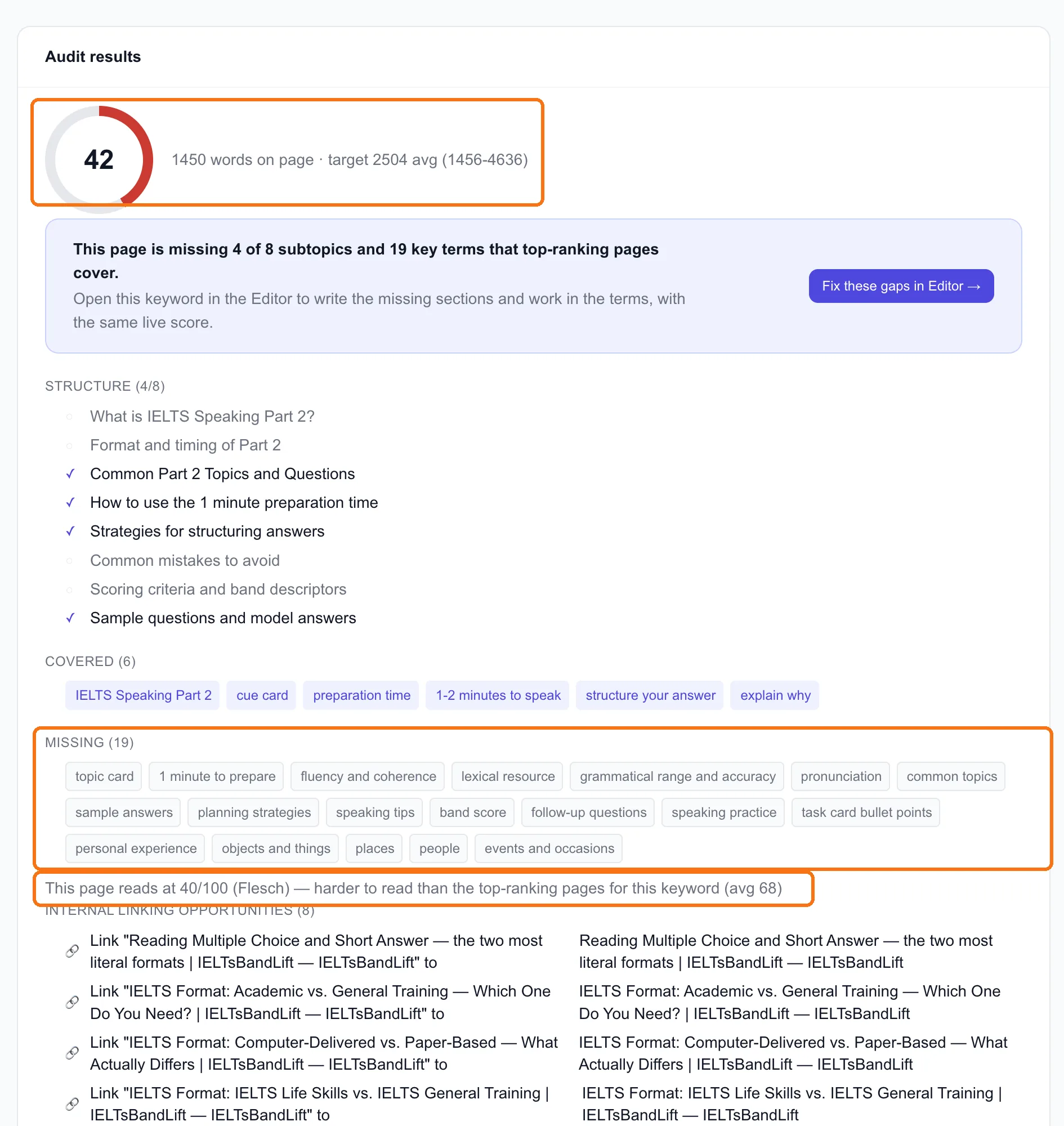
42. "Covered" in the Planner and 42 in the Audit. Both are true, and the difference is the lesson: the Planner checks that a page on the topic exists. The Audit checks whether it's as complete as the pages that win.
Here's what it found:
- Length: 1,450 words, against an average of 2,504 for the ranking pages (from 1,456 to 4,636). Ours is right at the bottom of the range.
- Structure: 4 of 8. We cover topics and questions, using the 1-minute preparation time, structuring answers, and sample answers. We're missing what Part 2 is, its format and timing, common mistakes, and scoring criteria and band descriptors.
- Missing terms: 19, including all four scoring criteria by name: fluency and coherence, lexical resource, grammatical range and accuracy, pronunciation.
- Readability: 40/100. The ranking pages average 68. Ours is noticeably harder to read, for an audience reading in their second language.
Step 3: Decide what to fix, in order
Don't try to fix all 19 terms. Fix what matters, most important first:
- Add the scoring criteria section. A page called "Anatomy of a Band 9 answer" that never explains what examiners score is missing its core. This one section covers the biggest gap and four of the missing terms at once.
- Add format and timing, and common mistakes. Two short sections, and the structure goes from 4/8 to 7/8.
- Make it easier to read. Shorter sentences, plainer words. Going from 40 toward 68 helps every reader, and it's the change most likely to help people actually finish the page.
- Then length takes care of itself. Three new sections will bring us near 2,000 words. We won't pad it any further.
Click Fix these gaps in Editor → to open the keyword in the Editor with the same live score, and work on the page there.
What to ignore
The Audit also lists internal linking opportunities. For this page, most were Reading and Listening guides: "Reading Multiple Choice and Short Answer", "Listening: Note-Taking Shorthand". They're our pages, but a reader on a Speaking Part 2 page has no reason to jump to them. A link should help the person reading. Add the two or three that do, and ignore the rest.
Tip: Audit the pages that already get impressions first. In Search Console (lesson 1.4), a page with impressions but few clicks is one Google already considers relevant. Improving it is usually faster than ranking a new one.
Done when
- You've audited one existing page against its real keyword
- You can say why it scored what it did: length, structure, terms, readability
- You have a short, ordered fix list, with the biggest gap first
- You've ignored the suggestions that don't help the reader