Some topics come in families. IELTS Speaking Part 1 asks about your hometown, your work, travel, technology, food and dozens of other topics, and people search for each one: "ielts speaking questions about hometown", "…about travel", and so on. Writing each page by hand is slow. Programmatic SEO writes the whole family from one template.
It's also the easiest way in SEO to fill a site with near-identical pages Google ignores. So we tried it small, and checked the result properly.
Step 1: Write the template and the list
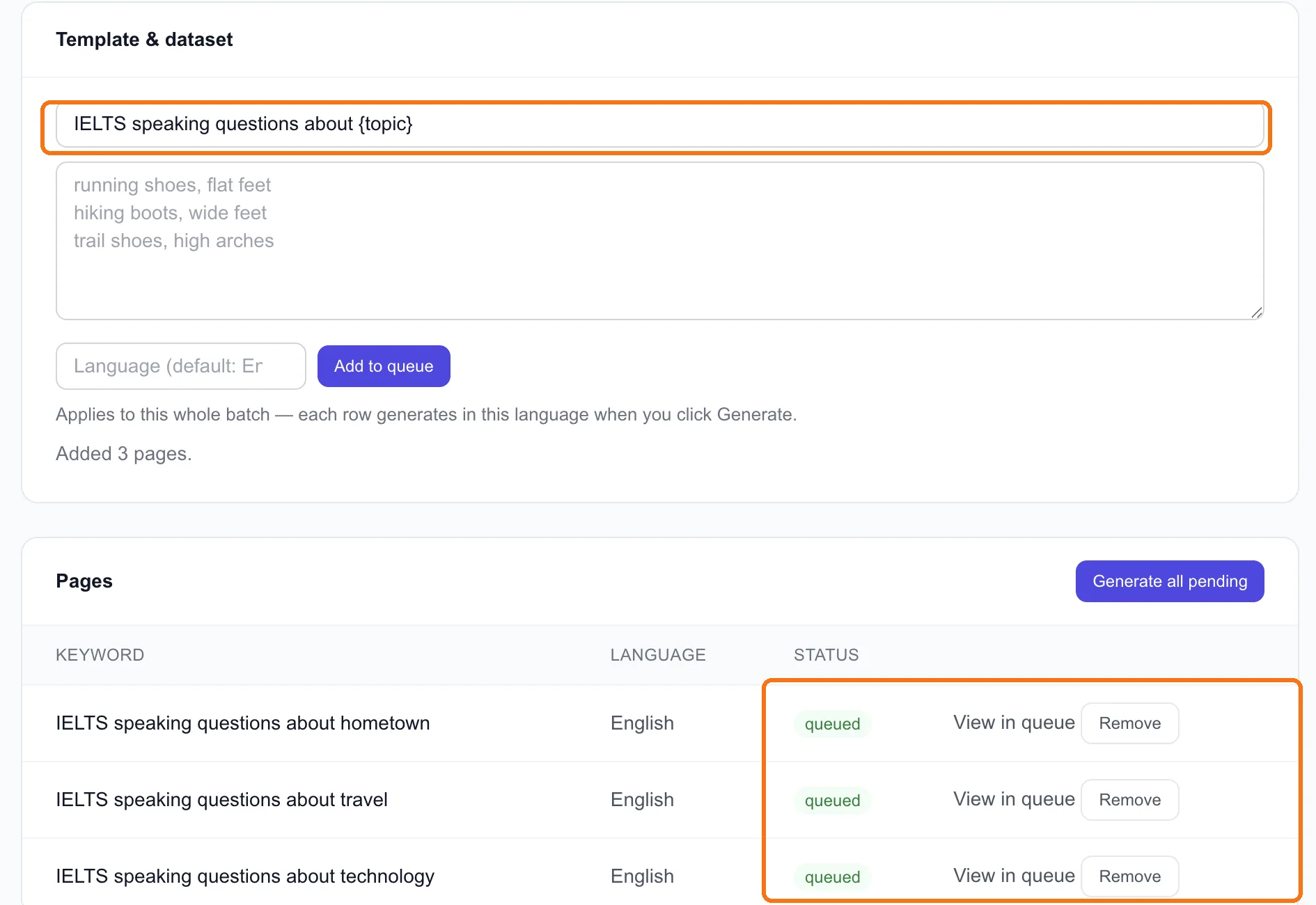
Open Programmatic SEO. Write a title template with {placeholders}, then one row per page, with the values in the same order as the placeholders, separated by commas.
Ours:
- Template:
IELTS speaking questions about {topic} - Rows:
hometown,travel,technology
Click Add to queue. Each row becomes a page waiting to be generated.
Step 2: Generate
Click Generate on a row, or Generate all pending. It asks you to confirm, because each page uses one of your monthly drafts, plus a keyword analysis if its topic is new.
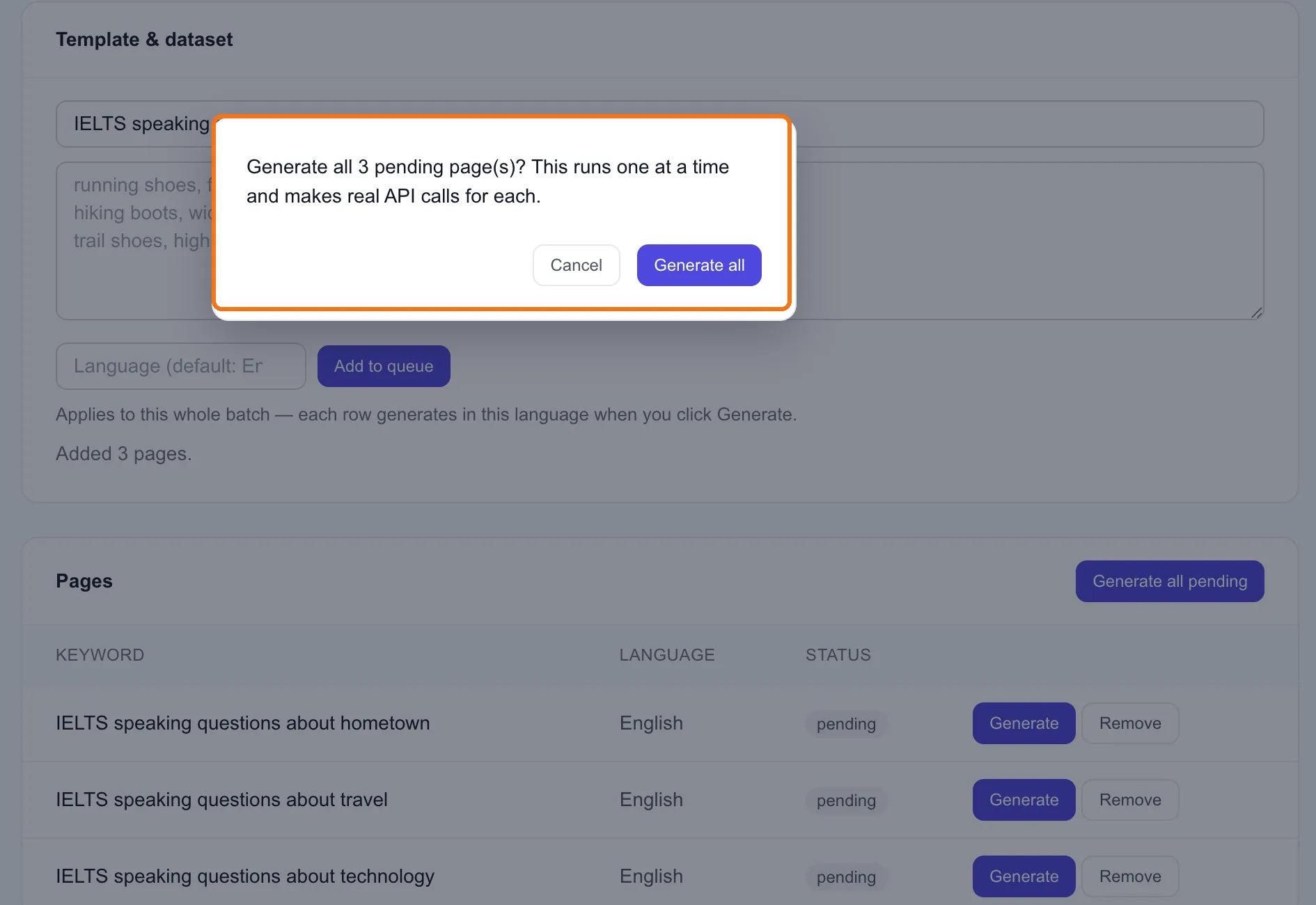
Pages are written one at a time. Each topic is analyzed like any keyword (lesson 2.2), written as a full draft (lesson 3.2), and sent to the Publish Queue. Ours took a few minutes for all three. Nothing publishes on its own.
Step 3: Check they're really different
This is the step that decides whether programmatic SEO helps you or hurts you. Here's what we got:
| Page | Words | First sections |
|---|---|---|
| …about hometown | 2,379 | Part 1 questions, vocabulary, sample answers, likes and dislikes, changes |
| …about travel | 1,918 | Travel preferences, memorable trips, travelling alone vs in groups, transport |
| …about technology | 2,051 | Part 1, 2 and 3 questions, vocabulary, impact on society and education |
Each page was researched separately against its own page one, so each has its own structure. We also compared the texts: only 2–3% of six-word phrases appear in any two of them. They aren't one article with a word swapped. Each one answers its own search.
Review still found something. The technology page refers to "Google Assist" instead of "Google Assistant". It's small, but it would go out on 1 of 3 pages, and on 1 of 50 in a bigger batch. Every programmatic page still needs reading before you approve it (lesson 4.2).
When it works, and when it doesn't
It works when every row has:
- Its own searches. People really do search "ielts speaking questions about travel". Check a few rows in Keyword Research before generating 50.
- Its own answer. Travel questions and technology questions need different examples, vocabulary and sample answers.
It doesn't work when:
- Only one word changes. "IELTS coaching in {city}" for a hundred cities, where every page says the same thing, is the classic thin-content trap.
- Rows need facts the writer can't know. We deliberately didn't try "IELTS score requirements for {country}". Visa and university requirements change, differ by programme, and a wrong number on a page like that does real harm. Pages like that need data you've checked, not generated text.
Tip: Start with three to five rows, like we did. Publish them, give them a month, and look at their clicks (lesson 6.1) before generating more. If three pages don't get traffic, fifty won't either.
Where we are: the three pages are in the Publish Queue, waiting for review. Together with the Part 1 and Part 3 pages from lesson 2.4, they start to fill out our speaking topic cluster.
Done when
- You've picked a family of topics where each one has its own searches and its own answer
- You've generated three to five pages, not fifty
- You've checked they're genuinely different, and read each one in the queue
- You have a date a month out to look at their results before doing more