Keyword research (lesson 2.1) tells you what people search. Competitor research tells you what already works: keywords a site like yours ranks for today, with real traffic behind them. It's the closest thing in SEO to copying a classmate's homework, and it's completely fair.
We looked at ieltsliz.com, a long-running IELTS teaching site that keeps coming up in our AI answers too (lesson 7.1).
Step 1: Research the domain
Open Competitors, type the domain, set the market (India for us) and click Research. A report uses one of your monthly competitor lookups (Pro includes 25), and it's kept for 30 days.
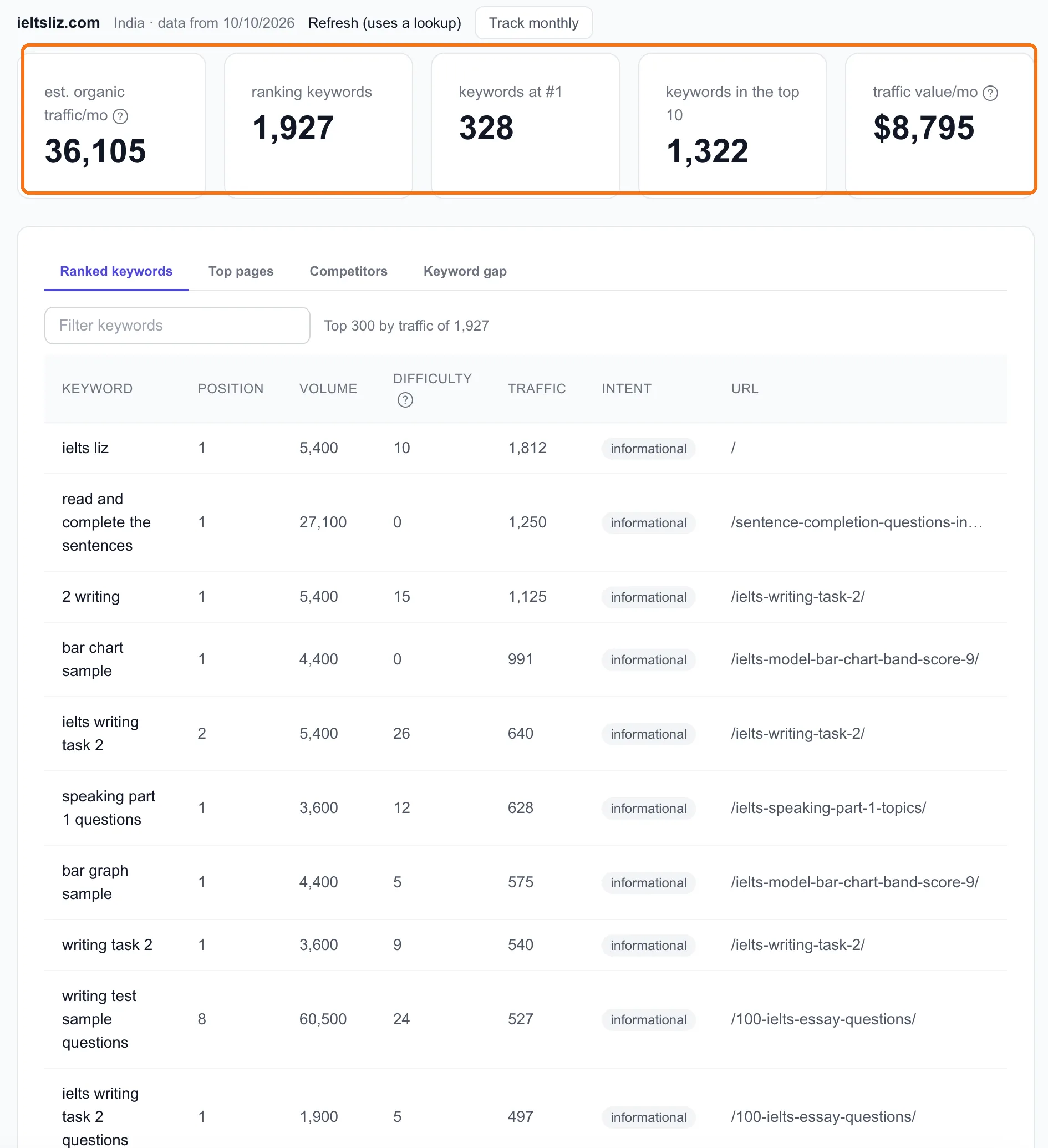
The top row is the scale of the gap:
- 36,105 estimated organic visits a month in India (ieltsbandlift.com: 8 clicks in 60 days)
- 1,927 ranking keywords, 328 of them at #1, 1,322 in the top 10
- $8,795 a month: what that traffic would cost in Google Ads
That last number is a good way to explain SEO to anyone who doubts it. This site would have to spend almost $9,000 a month on ads to buy the visitors it gets for free.
Step 2: Look at what's winning for them
Ranked keywords lists their keywords by the traffic they bring. A few things stood out in ieltsliz.com's:
- "read and complete the sentences" is #1, with 27,100 searches a month and a difficulty of 0. It's a reading question type. People search the instruction they see on the test paper, word for word.
- "bar chart sample" is #1, with 4,400 searches and difficulty 0. It's a Writing Task 1 model answer.
- "ielts liz" is their own name, at 5,400 searches. That's brand traffic, which you can't win. Skip anything with a competitor's name in it.
The pattern: their biggest wins aren't "IELTS tips". They're specific test tasks, phrased exactly as students meet them. That's worth knowing before you plan a single article.
Top pages shows the same thing by page. It's a good way to find their few pages that do most of the work.
Step 3: Run the keyword gap
Click Keyword gap, then Find my keyword gap. It lists keywords they rank for and your site doesn't, biggest first. It's one more lookup.
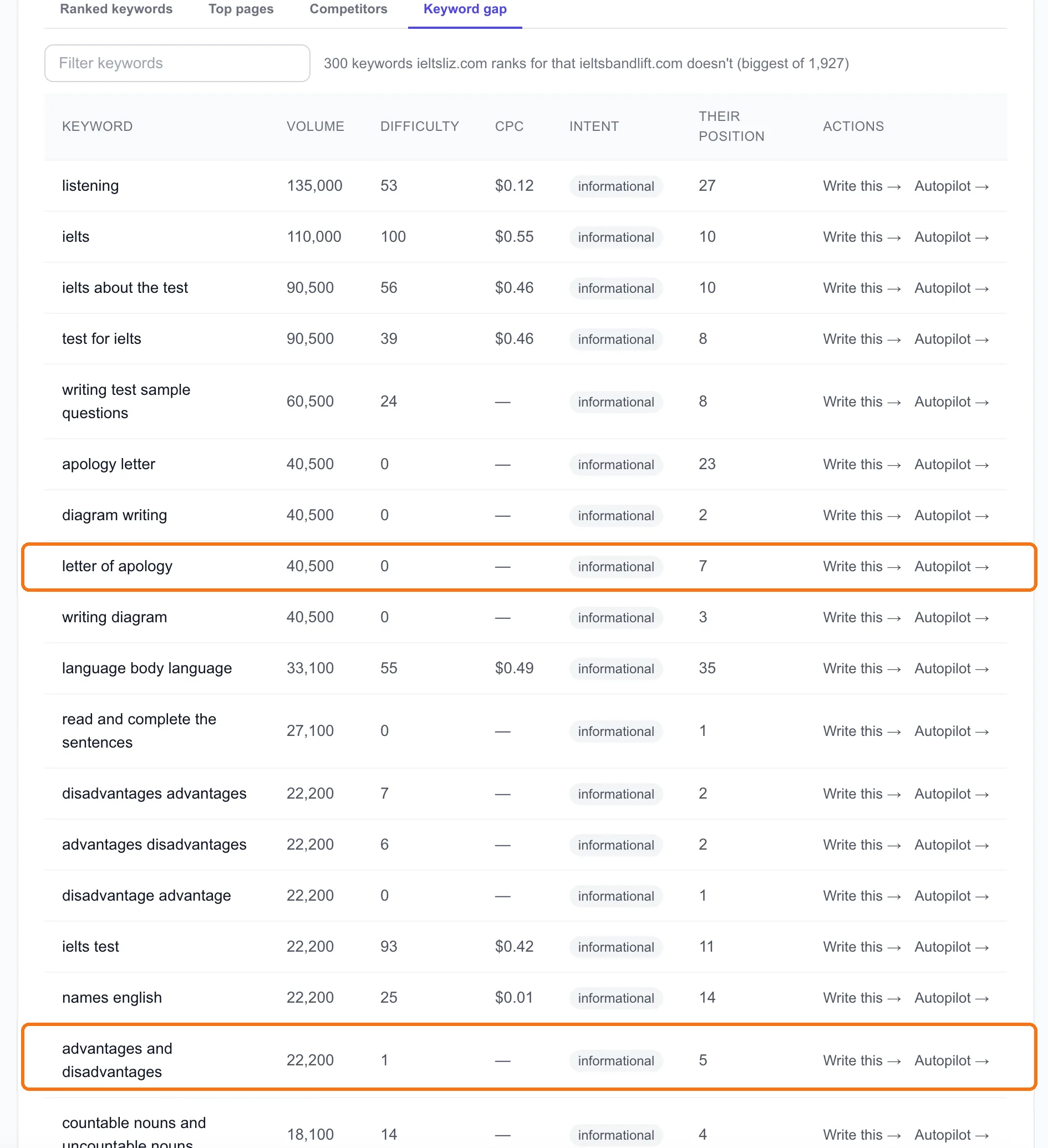
We got 300. Most of the top of the list is no use to us:
- "listening" (135,000) and "ielts" (110,000) are too broad. "ielts" has a difficulty of 100.
- "language body language" (33,100) is a page of theirs ranking for something unrelated to what we do.
Keep going down the list and the good ones appear. We picked two:
- "letter of apology": 40,500 searches a month, difficulty 0, and they're only #7. It's a General Training letter task, and we already have a page on band 9 GT letters to build from.
- "advantages and disadvantages": 22,200 searches, difficulty 1. It's one of the Task 2 essay types, and we already have a page on those too.
Both are big, easy, and right next to pages we've already written. That's what a good gap keyword looks like.
Tip: A competitor ranking #7 is a better target than one ranking #1. #1 usually means they've done the work and will defend it. #7 means Google isn't fully convinced by anyone yet.
Step 4: Act on it
Each row has Write this →, which opens the Editor on that keyword, and Autopilot →, which queues it as an Autopilot topic (lesson 4.3).
If a competitor matters to you, click Track monthly on their report. SEODojo follows their traffic and keywords against yours every month and emails you what changed (lesson 6.5). Tracking doesn't use lookups.
Pick the right competitors
Don't only research the giants. ieltsliz.com is a big, established site. Research a site closer to your own size too, because its wins are the ones you can copy soonest. A good set is one leader, one site about your size, and the site that keeps beating you for your most important keyword.
Done when
- You've researched one competitor in the right market
- You've noticed what kind of keywords bring them most of their traffic
- You've run a keyword gap and skipped the brand terms, the too-broad ones and the off-topic ones
- You have 3–5 gap keywords that are winnable and close to something you already do