One keyword, one article is how most people start, and it's how you end up with five thin articles all saying the same thing. Many searches are really one question asked different ways. "ielts speaking questions", "ielts speaking test" and "ielts speaking topics with answers" can often be answered by the same page.
The Content Planner takes a broad topic, finds the related searches, and groups the ones close enough in meaning to share an article. Each group is one article to write.
Step 1: Build a plan
Open Content Planner, type a broad topic (the help text's example is "running shoes", not "best running shoes for flat feet") and click Build content plan. It takes a few seconds and saves the plan, so you can leave and come back to it.
We used ielts speaking.
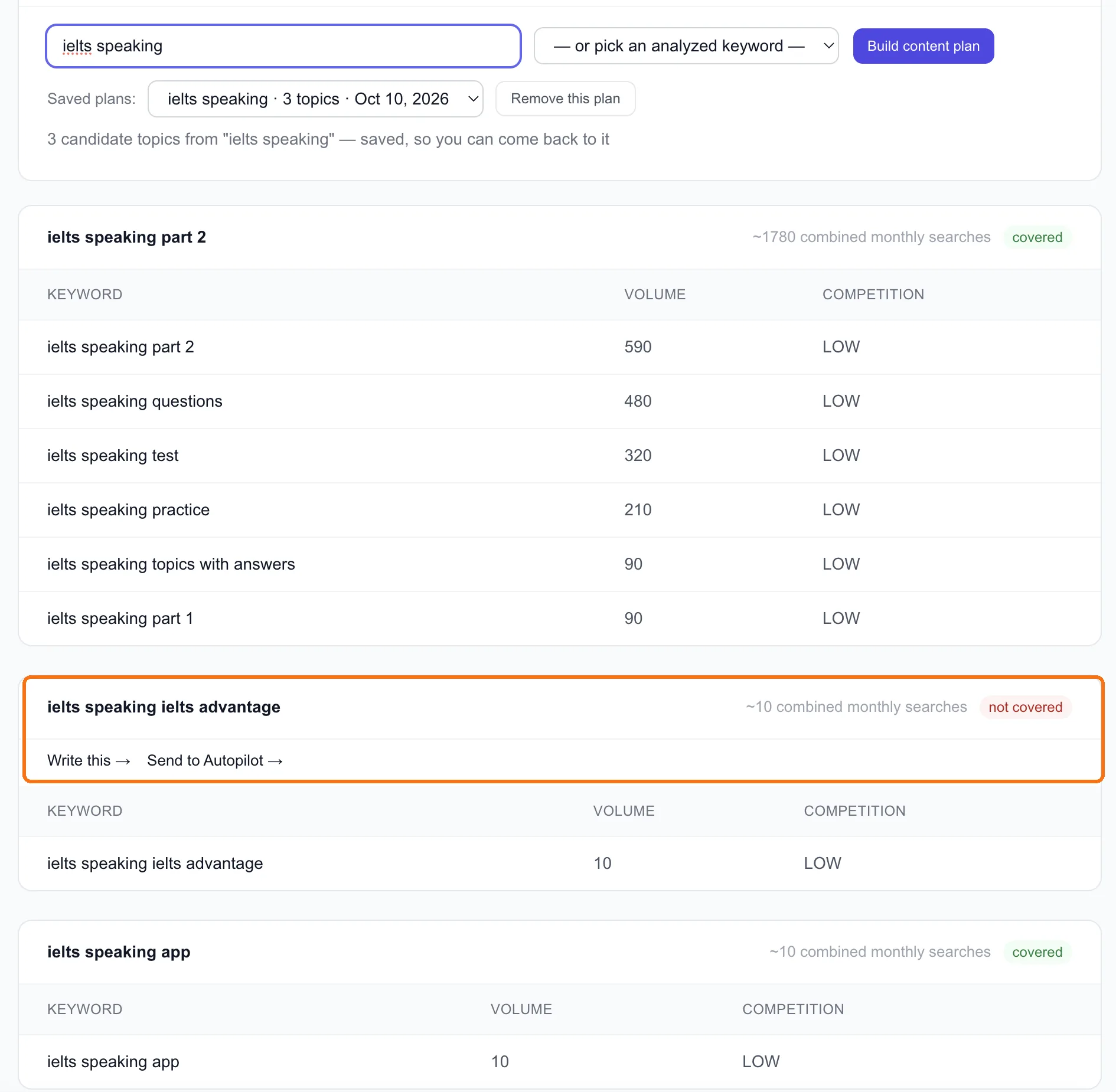
We got three candidate articles:
- ielts speaking part 2: about 1,780 searches a month combined, across six keywords: part 2, questions, test, practice, topics with answers and part 1. Marked covered.
- ielts speaking ielts advantage: about 10 a month. Not covered.
- ielts speaking app: about 10 a month. Covered.
Covered means a heading somewhere on your site is close to that topic. It's checked against your last site crawl (lesson 1.4), so crawl first or you won't see it. For us, the Part 2 cluster was most likely matched by our "Anatomy of a Band 9 Speaking Part 2 Answer" page.
Step 2: Don't trust the clusters blindly
This plan is useful, but not right as it stands. Here's what we'd change, and why you should look at yours the same way.
The first cluster is too big. It put Part 1, Part 2, "test" and "practice" in one article. They're related, but someone searching "ielts speaking part 1" wants Part 1 questions, and someone searching "part 2" wants cue cards and a long-turn answer. Those are different pages. We'd split it into three:
- Part 1 questions, with sample answers
- Part 2 cue cards, with a band 9 long-turn answer (we already have this one)
- A full speaking practice test, for "practice" and "test" (the page we briefed in lesson 2.2)
Skip the competitor's brand. "ielts speaking ielts advantage" is someone searching for another site by name. Ten searches a month, and they want that site, not yours. Never write for a competitor's brand name.
Check the market. The Planner has no market setting, so it uses the default, the United States. That's why every number here is small: "ielts speaking practice" shows 210, while Keyword Research gave us 1,900 for India (lesson 2.1). Use the Planner for the shape of the topic, then check the numbers in Keyword Research for your own market before deciding what comes first.
Tip: A cluster is a suggestion, not a decision. The test for whether two keywords belong in one article: would the same page fully satisfy both searchers? If you'd need two different intros, it's two articles.
Step 3: Turn it into a list
After our edits, the plan for "ielts speaking" is four pieces:
| Article | Status |
|---|---|
| Part 2 cue cards and a band 9 answer | Have it. Improve and link it |
| Full speaking practice test | Write next (lesson 7.5) |
| Part 1 questions with sample answers | Write |
| Part 3 discussion questions | Write. It wasn't in the plan, but page one covers it (lesson 2.2) |
That last row matters. The Planner only knows what people search. Page one tells you what a complete answer looks like. Use both.
Step 4: Send the articles on
Topics that aren't covered have Write this → (opens the Editor) and Send to Autopilot → (queues it for Autopilot, lesson 4.3). Topics you already cover don't, because the job there is improving the existing page, not writing a new one.
And when you write the cluster, link the pages to each other. Four articles that link to each other tell Google you cover the topic thoroughly. Four that don't are four orphans, and we already have 280 of those (lesson 1.4).
Done when
- You've built a plan for one broad topic, after crawling your site
- You've split any cluster that mixes different intents, and dropped competitor brand names
- You've checked the numbers that matter in your own market
- You have a short list: what you have, what to write, in what order