People don't type keywords into ChatGPT. They type questions, often long ones, sometimes with their whole situation attached: "I'm at band 6.5 in writing and need a 7 for Canada in two months, what should I use to practise?"
So the research is different too. A keyword list tells you what people search on Google. For AI answers you need a short list of real questions, called prompts, that you'll track (lesson 7.1).
Keywords vs prompts
| Keyword | Prompt | |
|---|---|---|
| Looks like | ielts speaking practice | how do I improve my IELTS speaking score |
| Typed into | ChatGPT, Perplexity, Gemini… | |
| You measure | Ranking and clicks | Whether you're named |
| Volume data | Good | Patchy |
That last row matters. SEODojo shows an AI searches / mo estimate next to each tracked prompt, but for specific questions it's often zero or missing. All five of ours showed 0. That doesn't mean nobody asks. Questions are so varied that no single wording piles up a measurable number. So don't choose prompts by volume. Choose them by how close the asker is to needing you.
Step 1: Let SEODojo suggest some
On AEO Check, under Tracked prompts, set the country and language, then click Suggest prompts. The suggestions come from your site and from the keywords you've researched (up to your 15 most recent), so do lesson 2.1 first and you'll get better ones.
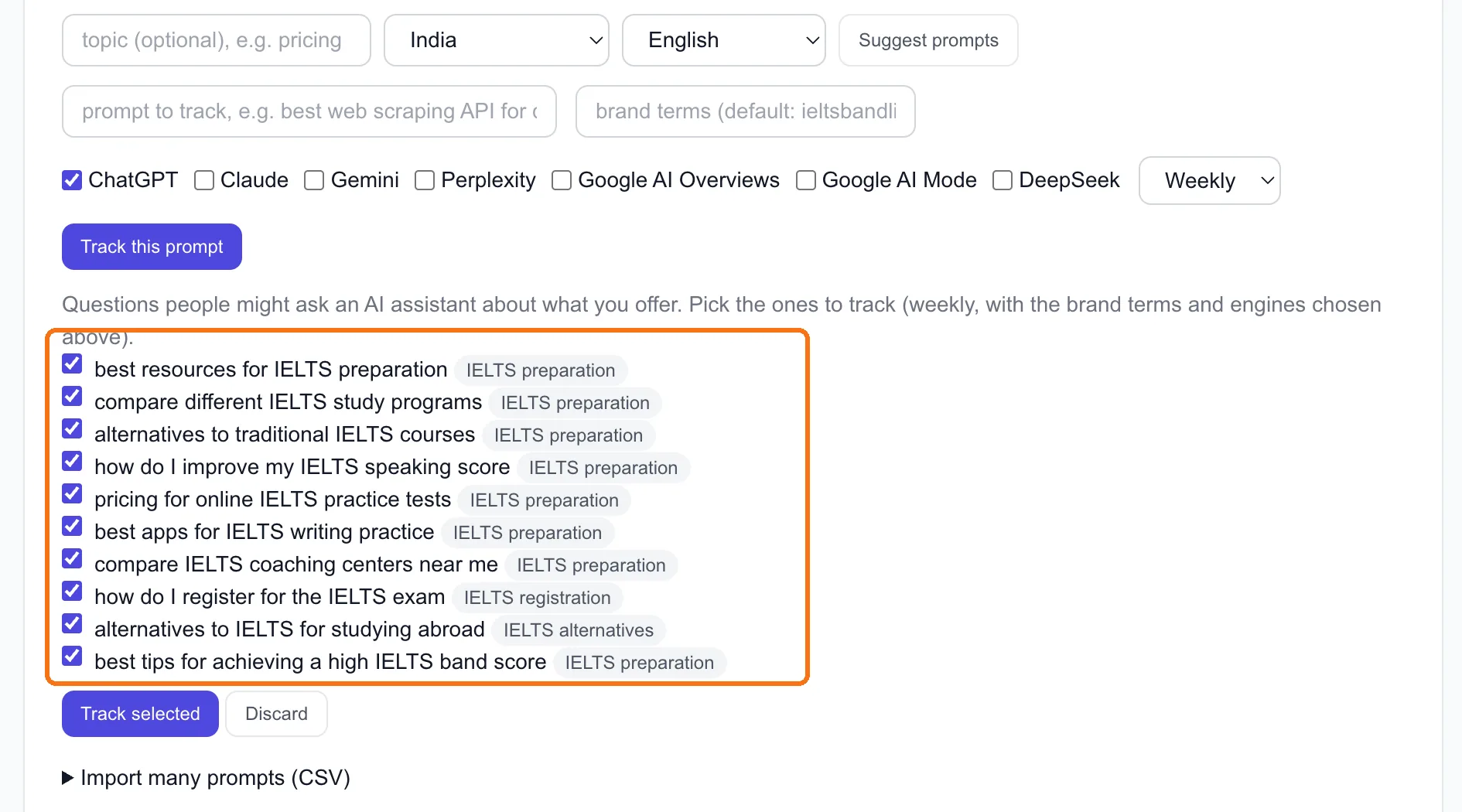
We got ten. Reading them is useful even before you track any. They show how your category sounds as a conversation: "best resources", "compare different study programs", "alternatives to traditional courses", "pricing for online practice tests".
Suggestions are free. Tracking them on a schedule is on Pro, and Free can check them by hand (lesson 7.1).
Step 2: Add the ones only you would think of
Suggestions are a start. The best prompts come from your customers' own words:
- Support emails and chats. How do people describe their problem before they've heard of you? "I keep getting 6 in writing and don't know why" is a prompt.
- Reddit and Quora threads in your category. The titles are often perfect prompts, and lesson 7.2 showed both sites turning up as AI sources for us.
- Google's "People also ask" box for your main keywords. It's literally a list of questions.
- Your sales or onboarding calls, if you have them. What do people ask before they buy?
Step 3: Keep only the prompts that could include you
This is the filter we used for ieltsbandlift.com, and it threw out half the list:
Would a good, honest answer to this question reasonably include us?
- "best apps for IELTS writing practice": yes. We're an app for exactly that. Keep.
- "pricing for online IELTS practice tests": yes. Answers list options and prices. Keep.
- "how do I register for the IELTS exam": no. The answer is always the official test sites. Drop.
- "compare IELTS coaching centers near me": no. We're not a centre. Drop.
Tracking prompts you can never be in only drags your visibility number down and hides the ones that matter.
Tip: Have a mix. A few "best X" and "X vs Y" questions, where people are choosing, and a few "how do I" questions, where answers often recommend a tool. The choosing questions are where being named is worth the most.
Step 4: Group them
Give each prompt a topic (the optional box next to the country). Ours are all "IELTS preparation" for now. As the list grows, topics let you filter AI Visibility by area, say speaking versus writing, and see where you're strong and where you're missing.
For a long list, Import many prompts (CSV) takes a file with prompt,topic on each line.
Done when
- You've generated suggestions after researching a few keywords
- You've added at least two prompts in your customers' own words, from support, forums or "People also ask"
- Every prompt on your list passes the test: a good answer could reasonably include you
- You have 5–10 prompts, each with a topic, ready to track in lesson 7.1