SEODojo has three checks for a draft before it goes out. We ran all three on our "ielts speaking practice" draft (lesson 3.2). It passed every one.
And it still had a sentence in it we'd never publish. This lesson is about why both of those are true.
Check 1: Check facts
In the Editor, click Check facts. It looks for specific claims in your draft (numbers, statistics, named products, dates) and flags any that aren't supported by the pages the keyword was analyzed from.
Our result: "No unsupported claims found against the source pages."
Good news, with an important limit. The check compares your draft with a sample of the ranking pages, not the whole web and not the truth. If those pages are wrong, or if a claim simply isn't in the part it reads, it won't tell you.
Here's the sentence it didn't flag:
Try to pause less than 3 seconds between ideas to improve fluency, which is needed for Band 7 or higher.
The official IELTS band descriptors have no "3 seconds" rule. It's the kind of precise-sounding detail AI writers produce, and a reader preparing for a real exam might take it literally. We cut it.
So: treat a flag as "go and check this", and no flags as "nothing obvious", never as "verified".
Check 2: Check originality
Next to it, Check originality shows how much of your draft is copied word for word from the pages the keyword was analyzed from. It's free and instant.
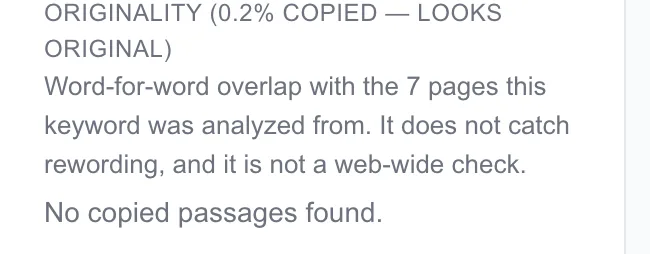
Ours: 0.2% copied, "looks original", with no copied passages found.
It works by matching runs of eight words in a row, so it catches copying, and lightly edited copying. It doesn't catch rewording, and it only checks against those analyzed pages (seven, for us), not the whole web. It's a "did this accidentally lift a competitor's paragraph" check. For that job, it's exactly right.
Check 3: The Humanizer
Open Humanizer in the sidebar, paste your draft and click Analyze. It scores how AI-written the text reads, from 0 to 100, and highlights stock "AI phrases".
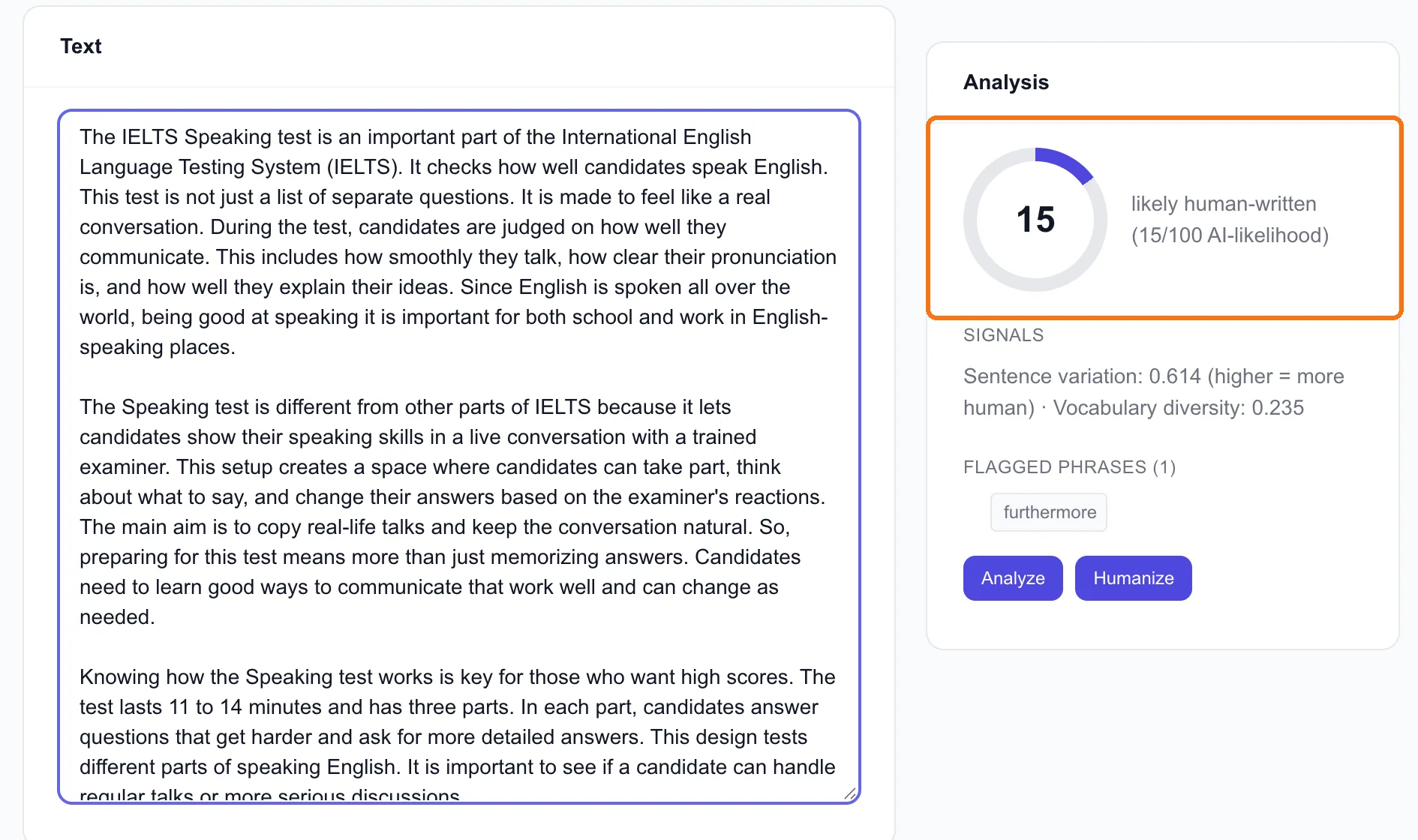
Our draft: 15/100, "likely human-written", with one flagged phrase ("furthermore").
That's the same draft whose opening we called generic in lesson 3.2. How?
The Humanizer is a quick heuristic, and the page says so: it measures how much sentence length varies, how varied the vocabulary is, and whether known clichés appear. It doesn't measure whether you said anything useful. A generic paragraph with varied sentences and no clichés scores "human".
Then we tried Humanize, which rewrites the text, on just the opening paragraph:
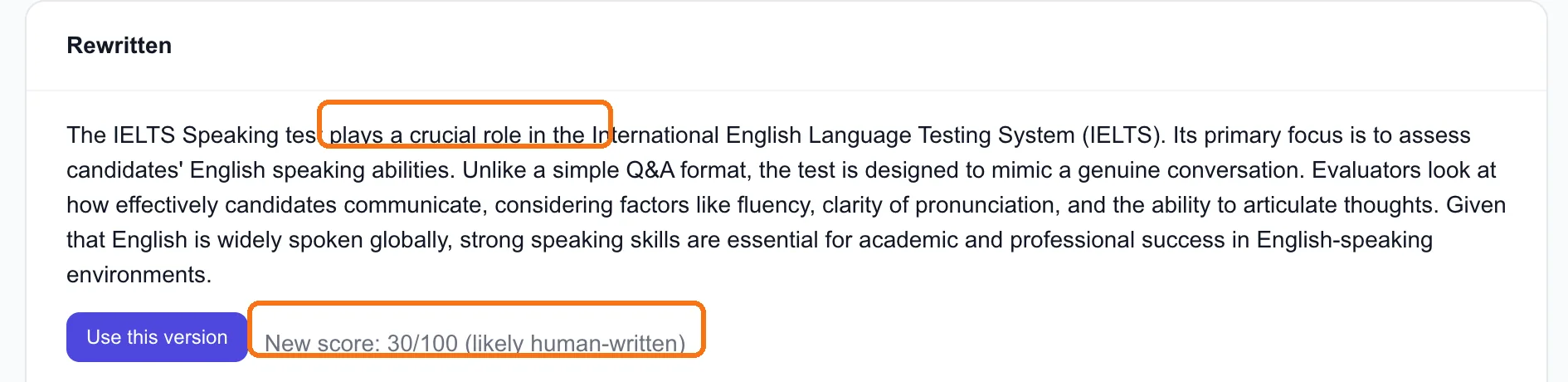
The rewrite starts "The IELTS Speaking test plays a crucial role in the International English Language Testing System", swaps "how well they explain their ideas" for "the ability to articulate thoughts", and scored 30/100, against 15 for the original draft. Different words, the same nothing, and more AI-sounding by the tool's own measure.
That's the real lesson of this tool: rewording doesn't fix generic writing. Only new content does: your data, your examples, your opinion. Use the Humanizer to spot clichés. Don't use it to "make AI text human". It can't.
Tip: The phrases it flags are worth knowing anyway: "in conclusion", "it's important to note", "moreover", "furthermore", "delve into", "game-changer", "seamless". Cut them on sight, in any draft.
Check 4: You
Here's the read that no tool does, in five minutes per draft:
- Every number and named fact: where's it from? If you can't say, cut it or check it.
- Every sentence about your product: is it true today?
- The first two sentences: do they answer the question? (lesson 3.3)
- One thing only you could have written: is it there?
- Read it out loud. You'll hear the generic bits.
Done when
- You've run Check facts, and checked or cut anything that sounds precise but has no source, flagged or not
- Originality shows no copied passages
- You've used the Humanizer to find clichés, not to rewrite
- You've done your own five-minute read, and the draft has at least one thing only you could write