An AI engine reading your page in a hurry is looking for one thing: a sentence it can lift and use as the answer. Google's featured snippets work much the same way. If your answer is buried in paragraph six, under three paragraphs of background, the engine takes it from someone else's page.
This lesson is about making your page the easy one to quote. None of it needs special tools. It's mostly how you write.
1. Put the answer in the first two sentences
Here's how our generated draft for "ielts speaking practice" opened (lesson 3.2):
The IELTS Speaking test is an important part of the International English Language Testing System (IELTS). It checks how well candidates speak English.
Nothing wrong with it, and nothing to quote. Someone searching "ielts speaking practice" already knows what the Speaking test is. They want to know how to practise.
A rewrite that answers first:
The fastest way to practise for IELTS Speaking is to answer real Part 1, 2 and 3 questions out loud, under test timing, and get feedback on each answer. Record yourself, check fluency, vocabulary, grammar and pronunciation against the band descriptors, and repeat the questions you struggle with.
The first sentence is a complete answer on its own. An engine can quote it, and a reader who stops there still got what they came for. The rest of the page then backs it up.
The test: cover everything after your second sentence. Did the reader get an answer? If not, rewrite the opening.
2. Use lists and tables where readers compare
When the question is "what are the options" or "what's the difference", answer in a shape that's easy to pull apart:
- Numbered steps for anything done in order: "How to prepare for Part 2 in one minute".
- Bulleted lists for options: "Ways to practise speaking alone".
- Tables for comparisons: Part 1 vs Part 2 vs Part 3, with time, format and what's scored.
Lesson 1.3 showed what AI engines cited for our questions: list articles and comparison pages, again and again. They get cited because the answer is already broken into pieces.
Don't overdo it. A page that's nothing but bullets reads like notes. Use a list where the content really is a list.
3. Add a short FAQ, with schema
End the page with three to five real questions and short, complete answers, two or three sentences each. Use the questions people actually ask: lesson 2.5's prompts and Google's "People also ask" box are good sources.
Then add FAQ schema: a small block of code that labels each question and answer for machines. SEODojo's free Schema Markup Generator makes it. It runs in your browser and sends nothing to a server.
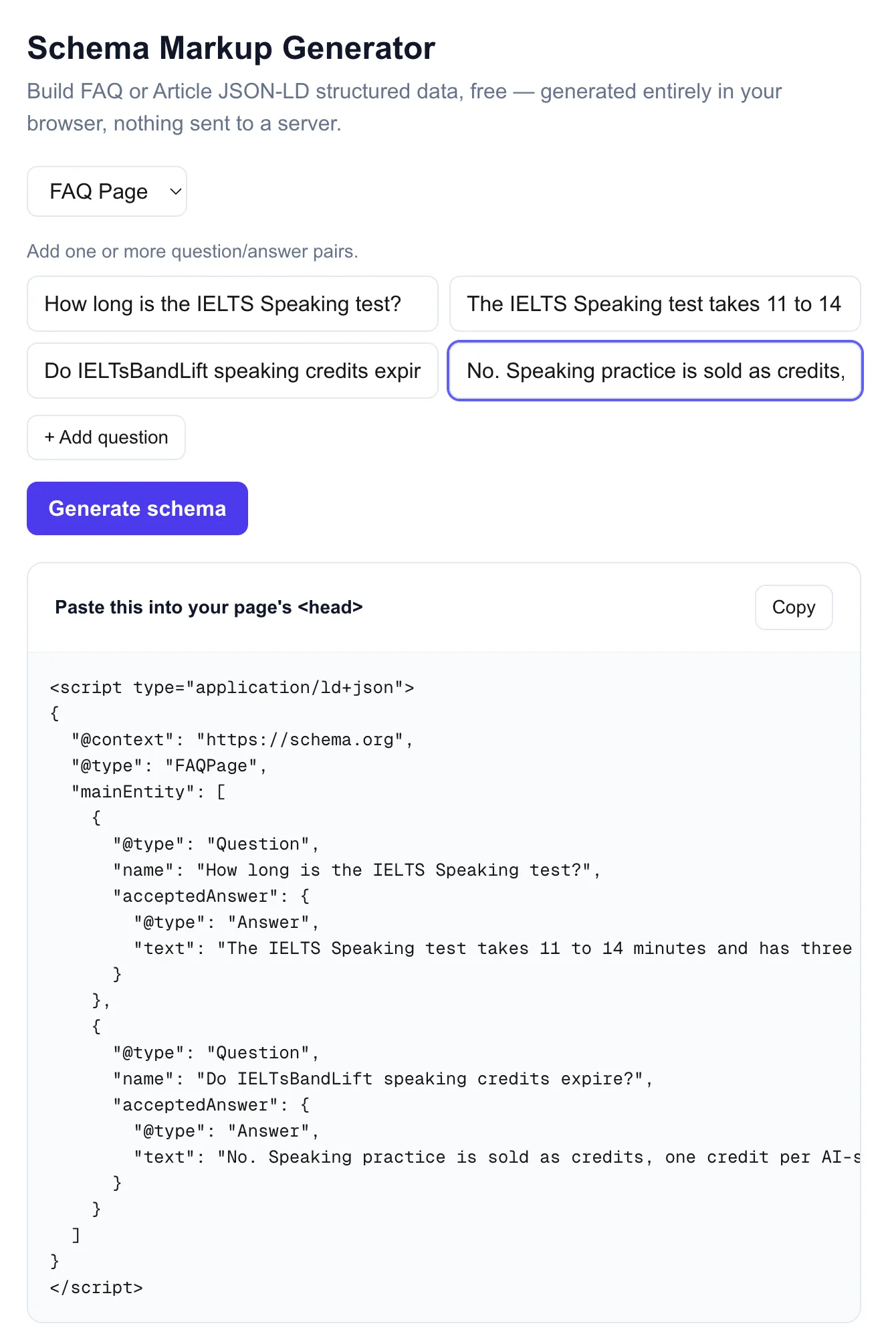
We added two:
- How long is the IELTS Speaking test? "The IELTS Speaking test takes 11 to 14 minutes and has three parts: an introduction and interview, a long turn on a cue card, and a two-way discussion."
- Do IELTsBandLift speaking credits expire? "No. Speaking practice is sold as credits, one credit per AI-scored session, and credits never expire."
The second is about us, and it's a fact from our own pricing page. That's deliberate. Brand questions are exactly where you want engines to quote you, not a third-party review (lesson 7.3).
Click Generate schema, then Copy, and paste the block into the page's <head>. Most CMSs have a field or plugin for it.
Note: Be realistic about schema. Since 2023, Google shows FAQ rich results only for a small set of well-known government and health sites, so don't expect the expanding questions under your result in Google. Schema still labels your questions and answers unambiguously for any machine reading the page. It costs nothing. Just don't add it expecting a ranking boost.
4. Say the things you'd want quoted, plainly
The last habit is the simplest. Wherever there's a fact about you that you'd like an AI engine to repeat, write it as a plain, complete sentence:
- "IELTsBandLift scores all four IELTS skills against the official band descriptors."
- "You get two scored Writing submissions free, no card needed."
Not in a graphic, not split across a pricing card, not implied. A sentence an engine can lift whole, and can't get wrong.
Done when
- Your first two sentences answer the searcher's question on their own
- Steps, options and comparisons are in lists or tables
- The page ends with a short FAQ of real questions, at least one about you
- FAQ schema is generated and pasted into the page's head
- Every fact you'd like quoted is a plain sentence somewhere on your site