Tracked prompts (lesson 7.1) tell you what the real apps say, week after week. Sometimes you just want to ask one question right now and read the answers next to each other. That's what Prompt Compare is for.
Ask one question, read two answers
Open Prompt Compare under AI Visibility. Type the question the way a customer would. In the second box, put your brand and your competitors, separated by commas, so every mention gets highlighted.
We asked: "What is the best AI tool to get my IELTS writing and speaking scored?" It's about as close to "should I buy ieltsbandlift.com?" as a question gets. We highlighted IELTsBandLift, IELTS Liz, E2 Language, Magoosh.
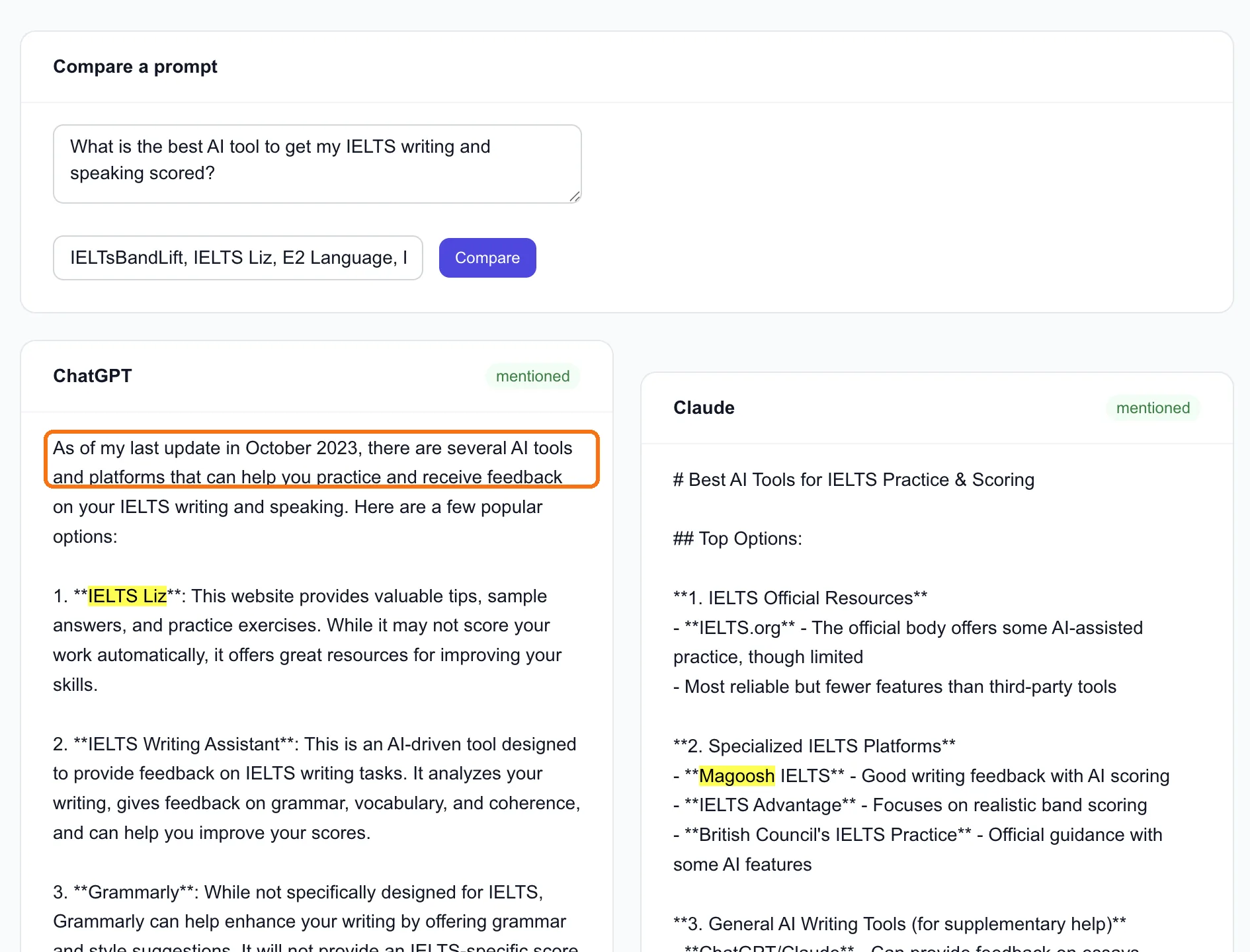
Both answers are marked mentioned, but not because of us. ChatGPT named IELTS Liz, Claude named Magoosh. Neither named IELTsBandLift.
What each one recommended:
- ChatGPT: IELTS Liz, an "IELTS Writing Assistant", Grammarly, Cambridge's Write & Improve, ELSA Speak.
- Claude: IELTS.org, Magoosh IELTS, IELTS Advantage, British Council, then ChatGPT, Claude itself and Grammarly as general tools.
Two different lists for the same question. Only Grammarly is on both. That's normal, and it's why one answer from one engine is never enough to judge where you stand.
Read the first line of ChatGPT's answer
Look at how ChatGPT's answer starts: "As of my last update in October 2023…"
That sentence tells you something important. Prompt Compare asks the models directly through their APIs, without web search. So the answer comes from what the model learned in training, not from today's web. Our app didn't exist in that data, so it can't be in the answer, however good our pages are.
That's the main thing this lesson is about. There are two kinds of AI visibility, and they move at very different speeds:
| Search answers | Memory answers | |
|---|---|---|
| Where they come from | Pages the engine finds today | What the model learned in training |
| Where you see them | Tracked prompts (the real apps) | Prompt Compare, DeepSeek |
| How fast they change | Weeks. Get onto a cited page and you can show up soon after | Months to years. Only when a new model is trained |
| What moves them | Being on the pages engines cite (lesson 7.2) | Being written about widely, for a long time |
For a new site like ours, search answers are where the work pays off this quarter. Memory answers are the long game, and they follow from the same work: every list you get onto and every article that mentions you is something a future model may learn from.
Note: DeepSeek never searches the web, so its tracked answers are memory answers too. That's why it never has sources in lesson 7.2.
When to use Prompt Compare
We use it for three things:
- Testing wording before you track it. "Best IELTS app" and "best AI tool to score my IELTS writing" get different answers. Try a few phrasings here, then track the one your customers actually use.
- Seeing your category through a model's memory. Which brands does a model name without searching? Those are the brands that have been written about the most. That tells you who's established, not just who's on page one this week.
- A quick check for a client or a colleague. It answers in a few seconds.
It uses AI-check credits: 1 for ChatGPT and 6 for Claude, so a two-model compare is 7. On the Free plan's 20 credits a month that's a couple of compares, so pick your questions carefully.
Tip: The Run a check box at the top of AEO Check is the other quick option. On paid plans it asks ChatGPT, Perplexity and Gemini with web search through their APIs. It's faster than a tracked run but costs more: 11 credits for ChatGPT, 3 for Perplexity and 15 for Gemini. Use it when you need a search answer right now, and tracked prompts for everything you want to follow over time.
Done when
- You've compared one real customer question on two models, with your brand and competitors highlighted
- You've noted which brands each model names from memory
- You know whether the answers you're reading are search answers or memory answers
- You've picked the wording you'll track, based on what you saw